Hemp Ban 2026
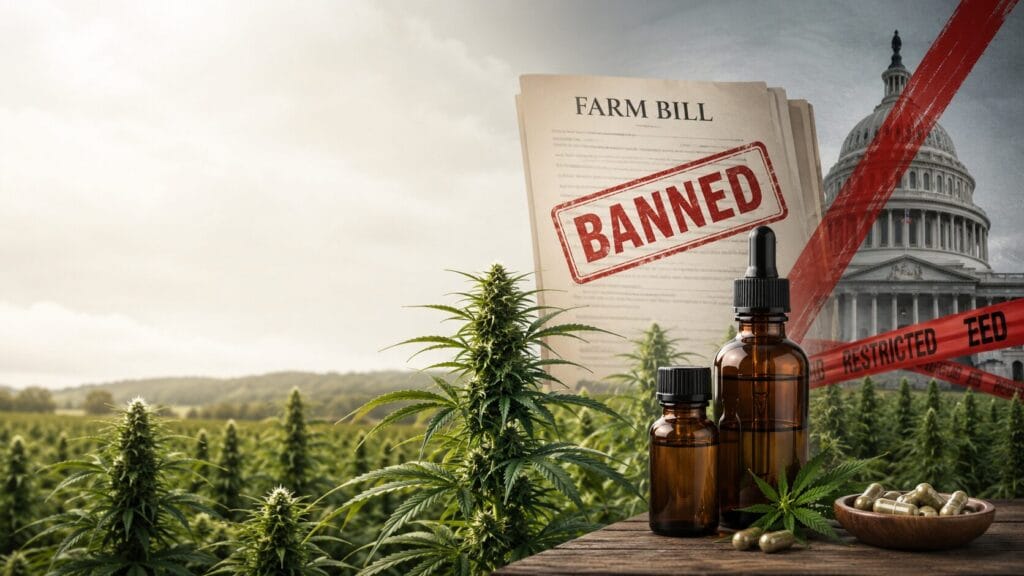
For years, full-spectrum CBD has occupied an important place in the hemp industry. It is not marketed as a high-THC product. It is not the same thing as an intoxicating delta-8 gummy or a high-dose THC beverage. It is a hemp extract designed to preserve the plant’s natural profile: CBD, minor cannabinoids, terpenes, and trace amounts of naturally occurring THC.
That distinction matters.
A new federal hemp restriction, however, may erase that distinction almost entirely. Under language enacted in H.R. 5371, final hemp-derived cannabinoid products would be excluded from the federal definition of hemp if they contain more than 0.4 milligrams of combined total THC per container, including THCA and other similar-effect cannabinoids. The same law also moves hemp from a delta-9 THC standard to a broader “total THC” standard that includes THCA.
On paper, the goal is easy to understand: Congress wants to address intoxicating hemp products, especially unregulated products sold without age gates, proper labeling, or safety standards. That is a legitimate policy concern.
The problem is the tool Congress chose.
A 0.4 mg THC limit per container does not just target intoxicating products. It can also capture ordinary full-spectrum CBD oils, softgels, gummies, topicals, and tinctures that contain only trace, naturally occurring THC. The law defines “container” as the innermost retail package, such as a bottle, jar, bag, can, carton, packet, or cartridge-not a serving.
That means a product can be non-intoxicating per serving and still fail the federal test because the entire bottle or package contains more than 0.4 mg total THC.
Hemp Does Not Naturally Produce “Zero THC”
The core problem is biological. Hemp is cannabis. It is bred to be low in THC, but it is not naturally THC-free. CBD itself is non-impairing, according to the CDC, but hemp-derived CBD products may still contain THC depending on the plant, extract type, manufacturing process, and testing standard.
That is exactly what “full-spectrum” means. These products are made to retain more of the plant’s naturally occurring compounds rather than isolate CBD alone. For many consumers, that whole-plant profile is the reason they choose full-spectrum products in the first place.
Under the 2018 Farm Bill framework, hemp was generally defined by a concentration threshold: no more than 0.3% delta-9 THC on a dry-weight basis. The new rule changes the practical reality for finished products by adding a hard milligram cap across the entire container.
That shift matters. A 30 mL tincture, a jar of balm, or a bottle of capsules could contain a trace amount of THC per use and still exceed 0.4 mg total THC in the package. At that point, the issue is no longer intoxication. It is math.
The Law Was Supposed to Target Intoxicating Products
There is broad agreement that the hemp marketplace needs better rules. Consumers should know what they are buying. Children should not have access to intoxicating cannabinoid products. Labels should be accurate. Products should be tested for potency, pesticides, heavy metals, solvents, and contaminants. Packaging should not imitate candy or appeal to minors.
There is also a clear policy interest in addressing converted and synthetic cannabinoids. The new federal language excludes cannabinoids that are not capable of being naturally produced by Cannabis sativa L., as well as naturally occurring cannabinoids that were synthesized or manufactured outside the plant.
That is where lawmakers should focus: intoxicating products, unsafe synthetic conversions, misleading labels, youth access, and untested products.
But a 0.4 mg per-container cap does something much broader. It treats a full-spectrum CBD tincture with trace THC like a high-potency intoxicating product. It does not distinguish between a product designed to intoxicate and a product designed for daily wellness. It does not distinguish between a 10 mg THC beverage and a CBD oil that contains a fraction of a milligram per serving.
That is not precision regulation. It is a near-ban by threshold.
Full-Spectrum CBD Consumers Could Lose Access
The people affected by this are not just hemp businesses. They are consumers who have built routines around full-spectrum CBD products.
Some use CBD for general wellness. Some are older adults looking for alternatives to alcohol or over-the-counter sleep products. Some are veterans. Some are people managing discomfort, stress, sleep issues, or other health concerns in consultation with their doctors. While companies must avoid unsupported disease-treatment claims, it is also true that the FDA has approved a purified CBD medication, Epidiolex, for seizures associated with specific rare conditions-evidence that cannabinoids are not a fringe topic in health care.
A responsible regulatory framework should protect consumers from unsafe products. It should not remove access to non-intoxicating full-spectrum hemp products simply because the plant naturally contains trace THC.
Farmers and Small Businesses Would Take the Hit
This rule also creates a serious economic problem for hemp farmers, extractors, manufacturers, retailers, laboratories, and brands that built compliant businesses under the prior federal framework.
Hemp companies invested in genetics, farming contracts, extraction equipment, third-party testing, packaging, compliance systems, and retail relationships. Many of those companies are not selling high-dose intoxicating products. They are selling CBD oils, capsules, gummies, balms, and pet products that consumers can buy in ordinary retail channels.
If the 0.4 mg cap takes effect as written, many of those products may be forced off the federal hemp market. Legal analysts and policy observers have warned that many, perhaps most, non-intoxicating CBD products could exceed the new 0.4 mg total THC per-container limit.
That would not just punish bad actors. It would punish the responsible operators who already test, label, and manufacture to higher standards.
Regulation Is the Better Path
The solution is not to ignore legitimate safety concerns. The solution is to regulate with precision.
Congress can still fix this before the November 12, 2026 effective date. A better framework would:
- Set intoxicating THC limits by serving and product type.
- Preserve non-intoxicating full-spectrum CBD products with trace, naturally occurring THC.
- Require third-party lab testing and batch-specific certificates of analysis.
- Ban unsafe synthetic cannabinoids and poorly controlled chemical conversions.
- Require age gates for intoxicating products.
- Mandate child-resistant packaging and prohibit marketing that appeals to minors.
- Protect interstate commerce for compliant hemp products.
- Give states a clear role in enforcement.
There is already movement in that direction. The bipartisan Hemp Safety Enforcement Act, introduced by Senators Amy Klobuchar, Rand Paul, and Joni Ernst, would allow states and Tribal governments to regulate hemp and hemp-derived products while preserving access to safe products and maintaining restrictions on dangerous synthetics.
That is the right conversation: safety, accountability, testing, labeling, age restrictions, and real enforcement.
Not a blanket threshold that wipes out full-spectrum CBD.
Protect Consumers Without Banning the Plant
The hemp industry does not need a free-for-all. It needs clear rules. Consumers deserve safe, tested, accurately labeled products. Parents deserve protections that keep intoxicating products away from children. Regulators deserve enforceable standards.
But the current 0.4 mg per-container language goes too far.
Full-spectrum CBD products are not the problem Congress set out to solve. Yet they may become collateral damage because the law treats naturally occurring trace THC as if it were the same as an intoxicating dose.
Congress should correct the language before it takes effect.
Regulate intoxicating hemp products. Ban unsafe synthetics. Enforce testing and labeling. Protect consumers.
But do not wipe out full-spectrum CBD in the process.