What Is Decarboxylation?
Decarboxylation is one of the most important words in hemp and cannabis, but it is also one of the easiest to misunderstand.
People often describe decarboxylation as “activation.” That can be partly useful, especially when talking about THCA converting into THC. But it can also create confusion, because it makes raw cannabinoids sound inactive or useless.
That is not accurate.
Decarboxylation is simply a chemical change. Heat, time, light, or processing conditions can change acidic cannabinoids like CBDA, CBGA, and THCA into neutral cannabinoids like CBD, CBG, and THC. That change matters, but it does not mean every hemp product should be aggressively heated or that raw cannabinoids have no value.
At Western MA Hemp, we care about decarboxylation because we care about the whole plant. Our goal is not just to chase one cannabinoid number. It is to preserve a broader hemp profile, including significant amounts of raw acidic cannabinoids, through our solventless, unrefined CO2 extraction process.
What Is Decarboxylation?
Decarboxylation is the process that changes acidic cannabinoids into neutral cannabinoids.
In simple terms, acidic cannabinoids have an extra chemical group called a carboxyl group. When enough heat, time, or processing energy is applied, that group can be released as carbon dioxide. The cannabinoid then changes into a different form.
That is why decarboxylation is sometimes shortened to “decarb.”
In hemp and cannabis, the common examples are:
| Raw acidic cannabinoid | After decarboxylation |
|---|---|
| CBDA | CBD |
| CBGA | CBG |
| THCA | THC |
| CBCA | CBC |
The raw form and the decarboxylated form are related, but they are not identical.
CBDA is not exactly the same thing as CBD. CBGA is not exactly the same thing as CBG. THCA is not exactly the same thing as THC.
Decarboxylation changes the product’s cannabinoid profile.
Why Does Decarboxylation Matter?
Decarboxylation matters because cannabinoids behave differently before and after heat.
The hemp plant naturally produces many cannabinoids in acidic form. That means fresh hemp flower can contain compounds such as CBDA, CBGA, and THCA before those compounds are converted into CBD, CBG, or THC.
When heat is applied, the balance can shift.
That shift can affect:
- The amount of acidic cannabinoids in the product
- The amount of neutral cannabinoids in the product
- The THC profile
- The lab report numbers
- The overall plant experience
- How processed or plant-forward the extract feels
This is why a lab report matters. A good certificate of analysis can show whether a product contains only neutral cannabinoids or whether acidic cannabinoids are still present too.
Is Decarboxylation the Same as Activation?
Not exactly.
The word “activation” is common, but it can oversimplify what is happening.
In a THC-focused context, the word makes some sense. THCA is non-intoxicating in its raw form. When THCA is heated, some of it can convert into delta-9 THC, which is intoxicating. That is why cannabis is heated for smoking, vaping, or certain edible preparation methods.
But hemp wellness is not only about intoxication.
When people say cannabinoids must be “activated” to work, they are usually ignoring raw cannabinoids. CBDA, CBGA, THCA, and other acidic cannabinoids do not need to become neutral cannabinoids to have biological activity or wellness value.
So a better way to say it is this:
Decarboxylation changes cannabinoids. It does not prove the raw forms are worthless.
Does CBD Need to Be Decarboxylated?
CBD itself does not need to be decarboxylated because CBD is already the neutral form.
What can be decarboxylated is CBDA, the acidic cannabinoid that can convert into CBD. If a hemp extract contains CBDA and it is heated enough, some of that CBDA can become CBD.
That is why two products can both come from hemp but show different cannabinoid profiles:
- One product may contain mostly CBD.
- Another product may contain a mix of CBD and CBDA.
- Another may preserve a broader range of acidic and neutral cannabinoids.
The best choice depends on the product’s purpose. A CBD isolate product may be designed to contain only CBD. A full spectrum hemp extract should be judged more broadly, because the whole profile matters.
What About CBG and CBGA?
CBGA is often called a precursor cannabinoid because the plant uses it as part of the pathway for other cannabinoids. Heat can also convert CBGA into CBG.
That does not mean CBGA should be treated as useless.
CBGA is part of the natural hemp profile, and preserving it can make a product feel more complete from a whole-plant perspective. A CBG-forward product can be especially interesting when it includes both CBG and CBGA rather than only one isolated number.
This is one reason Western MA Hemp cares about extraction parameters. The more aggressively a product is heated or refined, the more the raw cannabinoid profile can change.
What About THCA and THC?
THCA is the raw acidic form associated with THC. In its raw form, THCA is non-intoxicating. When enough heat is applied, some THCA can convert into delta-9 THC.
This is one of the main reasons decarboxylation gets so much attention.
For hemp products, THC levels matter for both experience and compliance. Full spectrum hemp products may contain trace THC, and customers should always review the product label and batch-specific lab report. People who are sensitive to THC, subject to drug testing, pregnant or nursing, taking medication, or managing a health condition should be especially cautious and talk with a qualified healthcare professional.
The key point is simple: decarboxylation can change the THC profile, so it should be controlled carefully.
How Heat, Time, and Processing Affect Hemp
Heat is the main thing people associate with decarboxylation, but it is not the only factor.
Cannabinoid acids can change through a combination of:
- Heat
- Time
- Light
- Air exposure
- Storage conditions
- Extraction method
- Manufacturing process
This is why hemp processing is not a small detail. A product’s final cannabinoid profile depends on how the plant was harvested, dried, extracted, stored, tested, and formulated.
More heat usually means more conversion, but the exact result depends on temperature, timing, and conditions.
That is why a serious hemp company should not treat extraction like an afterthought.
The Craft Is Balancing Conversion and Preservation
Good hemp extraction is not just about applying more heat.
There is a craft to balancing decarboxylation with preservation. Enough heat can convert acidic cannabinoids into neutral cannabinoids. Too much heat, too much time, or poor process control can damage the broader plant profile.
That broader profile includes terpenes and minor cannabinoids.
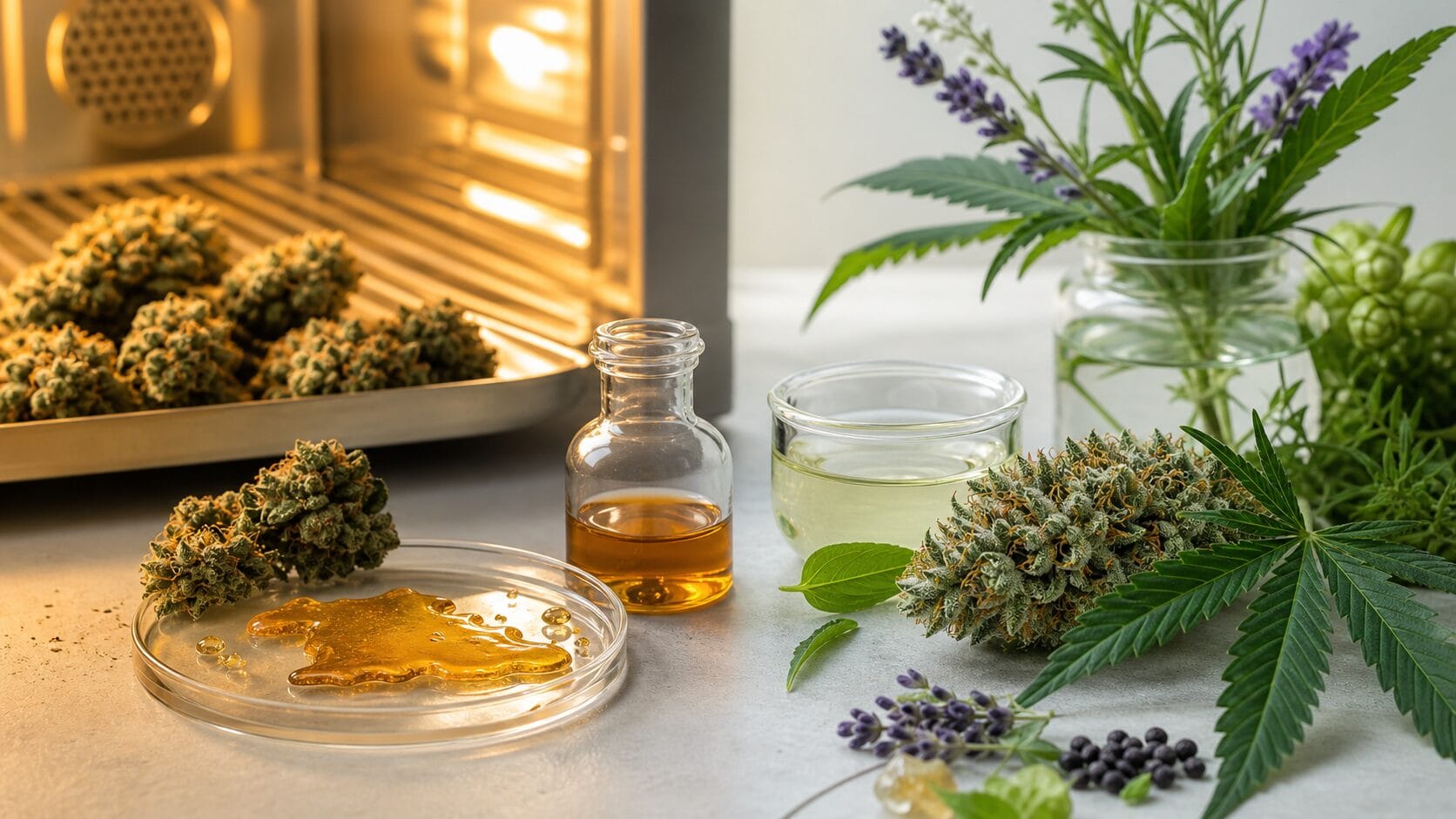
Terpenes are aromatic plant compounds that help give hemp its character. They are more volatile than cannabinoids, which means excessive heat can drive them off or reduce them before the finished product ever reaches the customer.
Minor cannabinoids can also be sensitive to processing conditions. A product may still show a strong CBD number after aggressive heat, but that does not mean the full spectrum was protected. If the process strips away terpenes, reduces acidic cannabinoids, or changes delicate minor cannabinoids, the extract becomes less complete.
That is the difference between crude heating and careful processing.
The goal is not to avoid decarboxylation completely. The goal is to manage it intelligently so the finished extract preserves more of what made the plant valuable in the first place.
Is Decarboxylation Bad?
No. Decarboxylation is not automatically bad.
It is a natural chemical process, and sometimes it is useful. If the goal is to create more CBD from CBDA, more CBG from CBGA, or more THC from THCA, then decarboxylation is part of that process.
The problem is assuming that more decarboxylation is always better.
For a whole-plant hemp product, preserving raw cannabinoids can be valuable. If every acidic cannabinoid is converted, overheated, or stripped away, the final extract may become less representative of the plant.
The same is true for terpenes and minor cannabinoids. If a process creates more neutral cannabinoids but sacrifices the supporting plant compounds, the product may look simpler on a label but less complete in the bottle.
The better question is not “was this decarboxylated?”
The better question is:
Was the process controlled in a way that matches the purpose of the product?
Why Raw Cannabinoids Still Matter
Raw cannabinoids are the plant’s natural acidic forms before heat changes them. They include compounds such as CBDA, CBGA, and THCA.
These compounds do not have to be heated to have therapeutic potential or wellness value. They are also non-intoxicating in their raw forms, which can make them an important part of a fuller hemp experience.
That is why the raw cannabinoid profile matters.
If a product only focuses on neutral CBD or CBG, it may miss part of what the plant naturally offers. If a product preserves both acidic and neutral cannabinoids, it can give customers a broader view of the hemp plant.
Our companion article, Raw Cannabinoids and Acidic Hemp Extract, explains this in more detail.
How Western MA Hemp Thinks About Decarboxylation
Western MA Hemp does not treat decarboxylation as a one-size-fits-all process.
Our products are made with special parameters in our solventless, unrefined CO2 extraction process. The goal is to preserve significant amounts of raw cannabinoids while still producing practical, consistent hemp extract products.
That means managing heat and pressure carefully. We are looking for balance: enough process control to make a stable, useful extract, but not so much aggressive heat or refinement that the terpenes, minor cannabinoids, and raw acidic cannabinoids are sacrificed.
That matters because we want our products to stay close to the plant:
- Full spectrum hemp extract
- Significant raw acidic cannabinoids
- Terpene and minor cannabinoid preservation
- Simple ingredients
- No unnecessary sugar or flavoring
- No synthetic cannabinoid profile
- No converted cannabinoid formulas
- Batch-specific lab testing
This approach fits our larger philosophy: full spectrum should mean more than a marketing phrase. It should reflect the plant’s natural complexity.
How to See Decarboxylation on a Lab Report
A lab report can help you understand whether a product contains mostly acidic cannabinoids, mostly neutral cannabinoids, or a mix of both.
Look for cannabinoid names such as:
- CBDA and CBD
- CBGA and CBG
- THCA and THC
- CBCA and CBC
If you see both forms, that can tell you the product preserved some raw cannabinoid content while also containing neutral cannabinoids.
Also check:
- Total CBD or CBG
- Total THC
- Delta-9 THC
- Acidic cannabinoid amounts
- Batch number
- Test date
- Product name
- Serving size
Western MA Hemp keeps current testing available on our Lab Results page, and our guide to reading hemp product lab tests explains how to understand the numbers.
Decarboxylation vs. Converted Cannabinoids
Decarboxylation is not the same thing as making converted cannabinoids.
Decarboxylation changes an acidic cannabinoid into its neutral form. For example, CBDA can become CBD, and THCA can become THC.
Converted cannabinoid products are different. Those products often involve chemical conversion from one cannabinoid into another compound that may not be naturally present in meaningful amounts in the plant.
That distinction matters.
Decarboxylation is a plant chemistry process that can happen with heat and time. Converted cannabinoid manufacturing is a separate process used to create a different cannabinoid profile.
Western MA Hemp focuses on real full spectrum hemp extract, not converted cannabinoid formulas.
The Bottom Line
Decarboxylation is the process that changes acidic cannabinoids into neutral cannabinoids. CBDA can become CBD. CBGA can become CBG. THCA can become THC.
That process matters because it changes the cannabinoid profile, including the THC profile. But decarboxylation should not be treated as a simple “good” or “bad” thing. It is a tool, and how it is managed depends on the product.
For whole-plant hemp, raw cannabinoids still matter. They are the plant’s natural form before heat, and they do not have to be converted to have wellness value.
Western MA Hemp uses special solventless, unrefined CO2 extraction parameters designed to preserve significant amounts of raw cannabinoids in our products. That helps keep the extract closer to the plant and gives customers a broader full spectrum experience.
If you want to understand what is in your hemp product, read the lab report. Look beyond one CBD number and pay attention to both acidic and neutral cannabinoids.
FAQ
What is decarboxylation?
Decarboxylation is the process that changes acidic cannabinoids into neutral cannabinoids. In hemp, CBDA can convert into CBD, CBGA can convert into CBG, and THCA can convert into THC.
Does hemp need to be decarboxylated?
Not always. Decarboxylation depends on the purpose of the product. Some products are designed to contain more neutral cannabinoids, while others preserve more raw acidic cannabinoids.
Does CBD need heat to work?
CBD itself is already the neutral form, so it does not need heat. CBDA, the acidic form, can convert into CBD with heat, but CBDA can still have wellness value before conversion.
Are raw cannabinoids inactive?
No. Raw cannabinoids are not useless or inactive. Acidic cannabinoids such as CBDA, CBGA, and THCA have their own biological activity and can contribute to a whole-plant hemp experience.
Is THCA intoxicating?
THCA is non-intoxicating in its raw form. Heat can convert some THCA into delta-9 THC, which is intoxicating.
Is decarboxylation bad for hemp extract?
Not necessarily. Decarboxylation is a normal chemical process. The important question is whether the process is controlled and whether the finished product matches its intended purpose. Too much heat can drive off terpenes and reduce minor cannabinoids, so careful processing matters.
How can I tell if a product contains raw cannabinoids?
Read the certificate of analysis, or COA. Look for acidic cannabinoids such as CBDA, CBGA, THCA, CBDVA, or CBCA, and make sure the report is current and batch-specific.